

PROJECT PRAMAAN
A Permanent, Zero-Leak, Self-Sustaining National Examination Architecture for India
Executive Summary: Project PRAMAAN is an end-to-end institutional proposal designed to eliminate paper leaks, remove logistics-driven public expenditure, restore credibility to academic degrees, and dramatically reduce the financial and psychological burden on millions of Indian students.
The Human & National Crisis — Why the Current Examination System is Broken
Every year in India, tens of millions of young aspirants dedicate the most productive years of their lives preparing for government recruitment, board certifications, and university degrees. Yet, the current operational framework faces chronic, systemic failures that impact governance and public trust:
The Paper Leak Tragedy
When an exam is cancelled due to paper leaks, it is not merely a logistical failure; it causes severe psychological shock, financial distress for underprivileged families, and administrative embarrassment. Even with severe penalties, leaks continue because the traditional workflow relies on high-value secrets handled by multiple intermediaries.
Extreme Logistics & Administrative Costs
To conduct a single large exam, district administrations requisition schools and private colleges, deploy tens of thousands of teachers and police personnel, order transport shutdowns, and suspend mobile internet. Teachers are diverted from classrooms, and regular public administration halts.
Commercialised Coaching & Unchecked Competition
Because students have no objective benchmark of where they stand before the real exam, millions enter examination halls blindly. This fuels an exploitative multi-billion-rupee coaching industry while crowding examination centres with candidates who have no statistical probability of clearing the merit threshold.
Devalued Educational Credentials
In many regional universities and open schooling boards, cheating and administrative laxity are pervasive. Consequently, degrees such as B.Sc., B.A., or state certificates lose credibility in the open market, forcing recruitment bodies to create duplicate screening exams for basic positions.
The Core Philosophy — The "Open Vault" Principle
Foundational Law of Cryptography
In traditional cybersecurity, there is a fundamental law known as Kerckhoffs's Principle: “A system should remain completely secure even if everything about the system, except the private key, is public knowledge.”
PRAMAAN applies this exact paradigm to public examinations:
The Fallacy of the 150-Question Secret
When an exam paper contains only 100 or 200 questions drafted by a handful of confidential experts, that question paper becomes worth crores of rupees on the black market. Leaking just 50 questions guarantees selection, making criminal bribery inevitable.
The Public Question Bank of Millions
PRAMAAN eliminates confidential paper creation. Instead, PRAMAAN hosts an open, publicly accessible, national Question Bank containing 3M+ vetted questions across all subjects on its official portal, categorized by discipline, topic, and difficulty.
Mathematical Immunity to Rote Learning & Leaks
When questions are already public and count in the hundreds of thousands, "leaking" becomes mathematically impossible. No individual can memorize 3M+ answers. The only way to succeed is through genuine conceptual mastery.
Standardized Difficulty Tagging
Every single question in the bank is tagged with its precise discipline, topic, and calibrated difficulty rating.
The Architecture — How PRAMAAN Operates End-to-End
1. Single Universal Identity & Score Repository
PRAMAAN is not a recruitment agency; it does not issue job appointment letters. Instead, it functions as a trusted national testing and score-verification authority across central and state domains:
Zero Registration Clutter
Students do not create redundant accounts across dozens of departmental portals. Aspirants authenticate seamlessly using their national identity with direct OTP verification.
Tamper-Proof Credential Vault
All exam records, board certifications, and competitive scores are cryptographically locked within the PRAMAAN repository. Candidates can directly download their verified digital certificates and scorecards, while colleges, universities, and employers can verify them via authorized APIs upon real-time OTP consent from the candidate.
2. The Hardware: Custom, Low-Power PRAMAAN Tablets
Relying on rented commercial computer labs introduces vulnerabilities (screen sharing, remote desktop utilities, and hardware keyloggers). PRAMAAN solves this with custom-engineered hardware and strict software lockdown architecture:
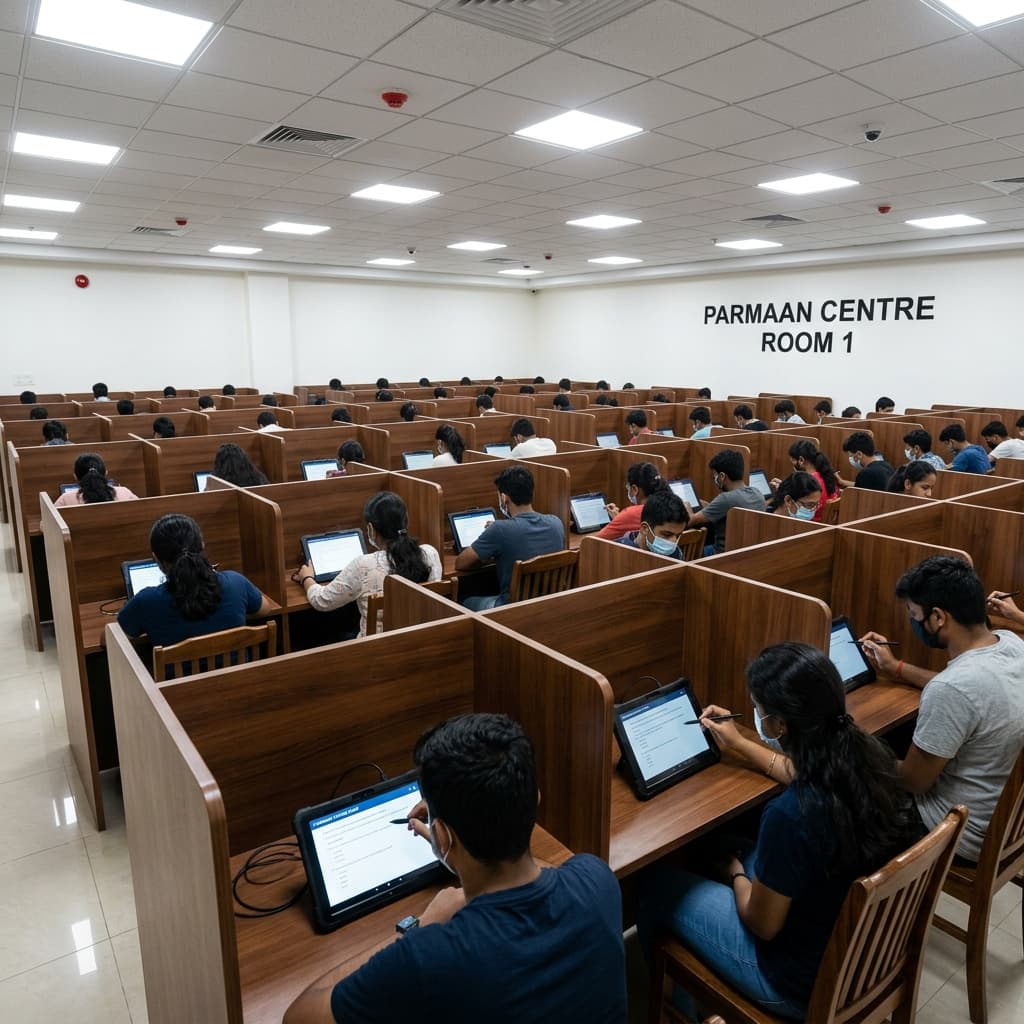
11-Inch Dedicated Consumer Android Terminals
Powered by octa-core ARM processors and 4GB RAM, paired with active capacitive styluses for precise on-screen rough work and descriptive inputs.
PoE Hardwiring & Radio Disablement
Connected exclusively via IEEE 802.3af Power-over-Ethernet (PoE) to USB-C splitters, delivering continuous regulated power and wired Ethernet (eth0). Wi-Fi, Bluetooth, cellular radios, and USB/ADB data interfaces are permanently disabled at the hardware and kernel level.
OS Lockdown & Strict Kiosk Mode
Managed via an enterprise Device Policy Controller (DPC) enforcing single-app LockTaskMode, suppressing system notifications, navigation gestures, and task-switching.
Silicon Root of Trust & Cryptographic Identity
Hardware security is anchored in ARM TrustZone / StrongBox KeyStore containing non-exportable private keys for hardware-bound Mutual TLS (mTLS) authentication.
Integrity Attestation & Zero Local Storage Persistence
Utilizes Android Verified Boot (AVB 2.0) and dm-verity to guarantee firmware integrity. Examination data streams directly into volatile RAM with zero local non-volatile storage persistence.
3. The Physical Fortress: District PRAMAAN Examination Hubs
Instead of ad-hoc seasonal rentals, the state constructs or designates permanent, highly secure 3-4 storey PRAMAAN testing centers in every district:
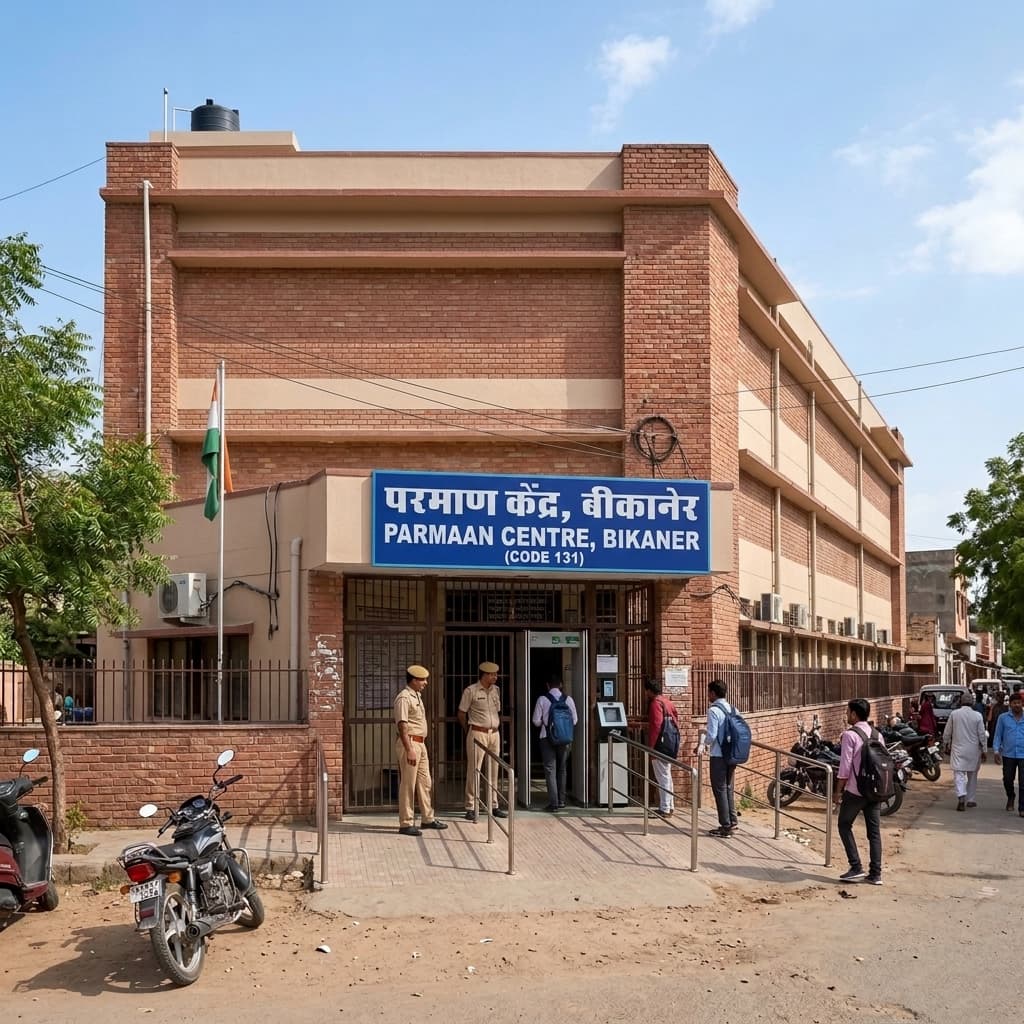
Windowless Enclosure & Single Entry/Exit
The structural layout eliminates exterior perimeters where notes or devices could be thrown in. A single, monitored gateway governs all access.
Faraday Shielding & RF Attenuation
Testing halls are built with continuous aluminum mesh/Faraday shielding inside walls and ceilings, backed by authorized RF suppression. Wireless devices, spy earpieces, and Bluetooth relays cannot receive or transmit data inside the testing bays.
Centralized External HVAC
Air conditioning plants are positioned entirely outside the secure zone, preventing unauthorized entry under the guise of facility maintenance.
Non-Combustible Metal Interiors
Examination desks, privacy dividers, and seating are manufactured from high-grade, fire-retardant metals, ensuring comprehensive structural safety.
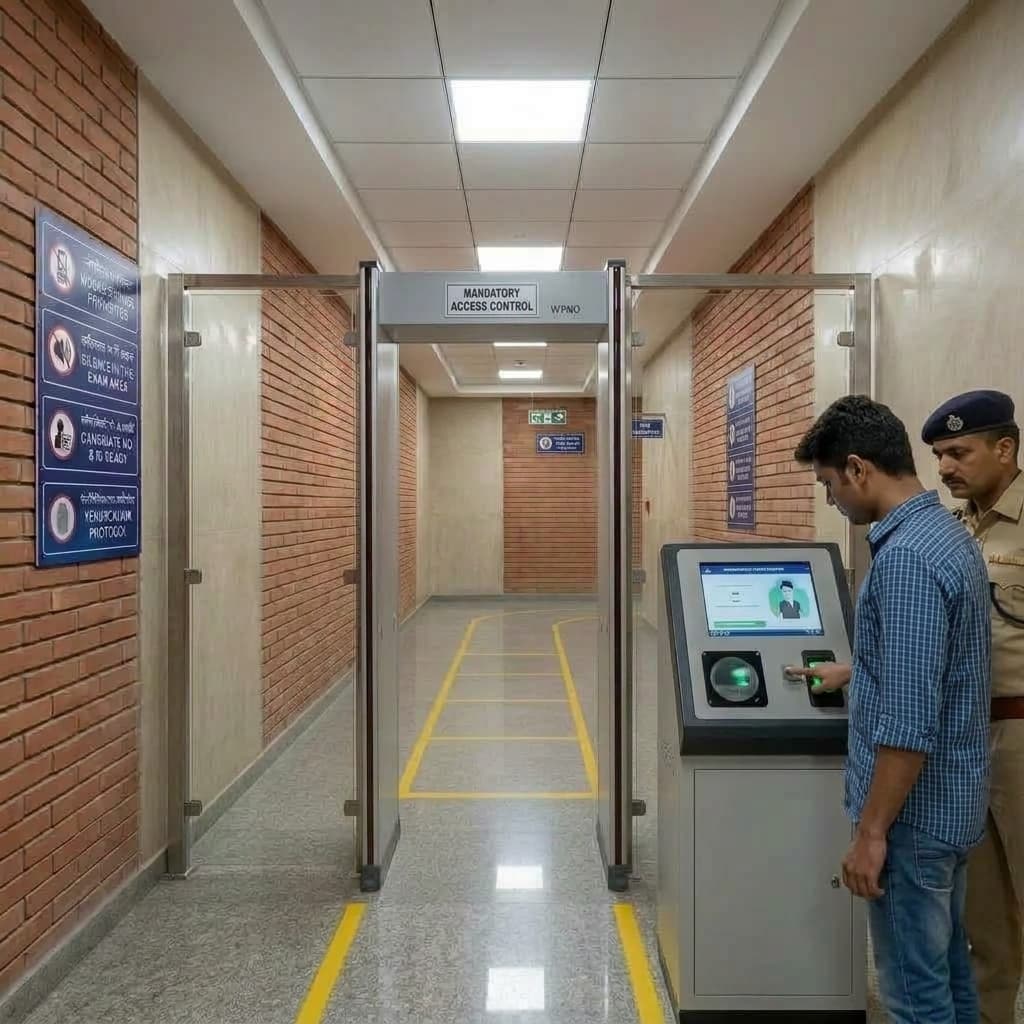
Three-Tier Physical Screening
Candidates pass through three separate biometric and metal detection checkpoints. With all scratch pads and pens replaced by digital styluses, bringing any metallic or electronic item inside is strictly prohibited.
Minimal On-Site Staff (3-4 Guards)
On-site personnel are limited strictly to external physical security and entrance verification. No local official has access to question distribution, servers, or test allocation, eliminating staff-level extortion or collusion.
4. Cryptographic Security & Dynamic Test Generation
Random Real-Time Assembly
When a student logs into their allocated terminal, the centralized engine pulls a uniquely balanced, randomized set of 100–400 questions from the massive public repository matching the examination's psychometric criteria.
Hardware-Bound Keys
Each tablet features cryptographically burned identification keys. Communication with the central PRAMAAN secure server utilizes end-to-end encryption with SHA-512 hashing. No intermediary, local administrator, or network sniffer can inject answers or intercept questions.
Optional IRT Calibration & Equating
While standard random assembly from calibrated pools naturally yields balanced papers, Item Response Theory (IRT) can be enabled as an additional safeguard. By matching Target Information Functions across tests, IRT ensures mathematically precise score equating and percentile normalization for complete cohort fairness.
5. Institutional Governance, High-Talent Cadre & Strict Accountability
Corporate Agility with 100% Government Ownership
PRAMAAN is structured as a corporatized entity operating with the speed, efficiency, and technological rigor of a modern tech company, while remaining under 100% central government equity and sovereign control.
Market-Competitive Compensation for Skilled IT Talent
While PRAMAAN requires high-caliber professionals with robust technical and domain expertise well above standard administrative hiring profiles, it does not require ultra-niche or premier deep-tech cryptographers. Compensation structures are designed to attract competent, reliable software, systems, and security engineering talent to build and maintain public infrastructure efficiently.
Ultra-Lean Operational Headcount
The institutional structure maintains a lean personnel footprint across central headquarters and district hubs, minimizing human touchpoints and potential attack vectors.
Anti-Corruption Penalties
Any internal compromise, collusion, or deliberate security breach is classified as an offense against national infrastructure, subjecting offenders to severe penal consequences to safeguard national interests.
Transforming the Student Experience & National Culture
1. Real-Time Pre-Exam Mock Testing: Ending Blind Hope
Before stepping into a high-stakes exam, students can take identical full-length mock tests on PRAMAAN's portal, drawn dynamically from the same public question bank under identical timing and scoring parameters:
Accurate Benchmark
Candidates immediately discover their calibrated percentile against the historical cutoff.
Elimination of Unprepared Crowds
Aspirants scoring significantly below qualifying thresholds naturally choose to prepare further rather than congesting physical exam centres.
Mental Health Protection
Instant familiarity with one's genuine standing removes sudden shock, despair, and tragic mental health outcomes often triggered by unexpected exam results.
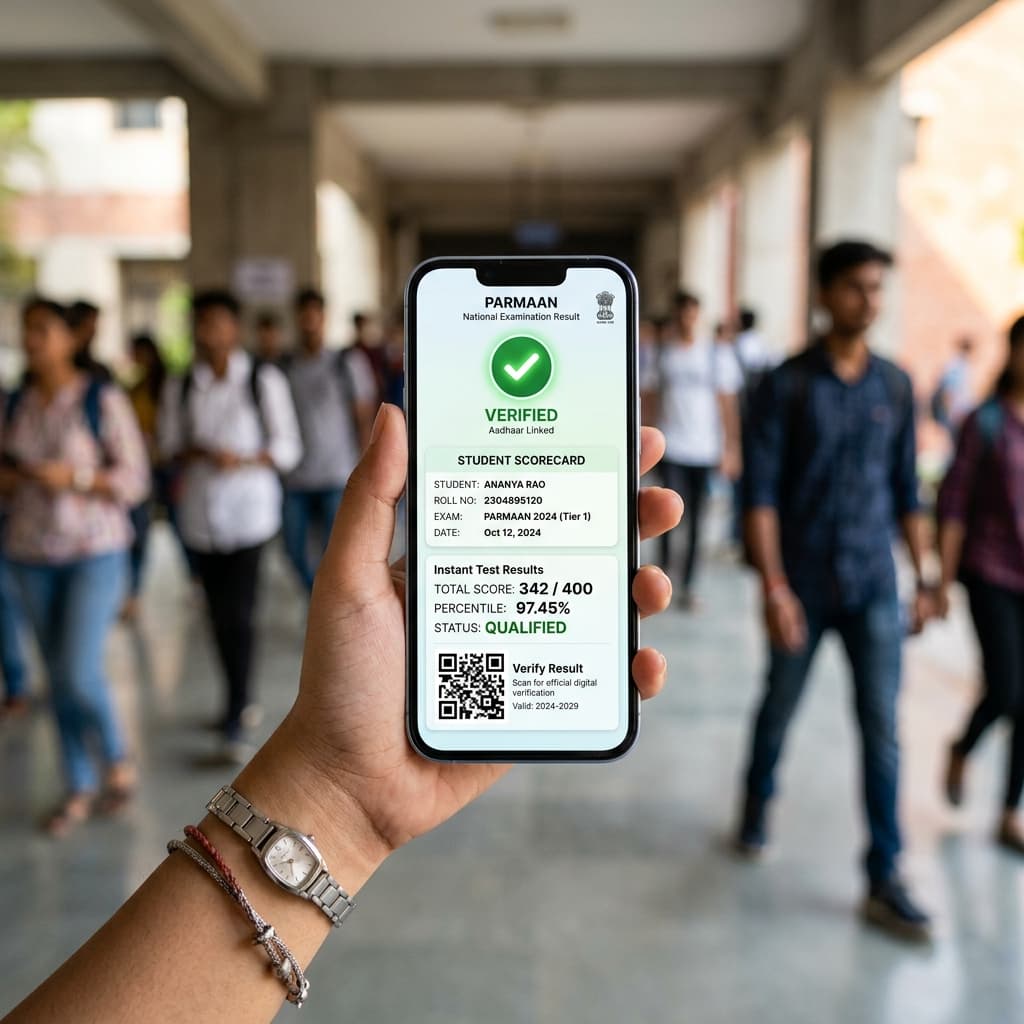
2. Instant Results (Within 60 Seconds)
The moment an applicant clicks "Submit," automated server scoring processes their choices against verified keys. Within one minute, the comprehensive scorecard, question-by-question response sheet, and percentile are updated directly in their authenticated profile. This completely eliminates month-long delays, court stays, and post-exam tampering.
3. On-Demand Testing & Academic Decongesting
While massive competitive selections can occur in organized time windows, recurring certifications (open board examinations, 10th/12th equivalencies, and computer literacy diplomas) shift to an on-demand slot-booking model:
Candidates book open testing slots across the year when they feel fully prepared.
Mass student migration, overcrowded train transit, and railway station congestion are permanently replaced by an orderly, continuous trickle of candidates throughout 365 days.
4. Departmental In-Service Skill Assessments
When state or central governments introduce new legislative acts or administrative protocols (e.g., new criminal statutes or digital service procedures), departments can mandate on-demand verification through PRAMAAN. For example, 5% of police personnel from a district can take verified assessments daily on rotation without compromising active field deployments.
Financial Viability & Economic Model
The conventional examination model drains thousands of crores from public treasuries and candidate savings. PRAMAAN inverts this entirely into a self-funding public asset.
The "1 Rupee Per Minute" Pricing Framework
PRAMAAN introduces a transparent, universally affordable fee schedule based purely on examination duration: ₹1.00 per test minute.
| Examination Category | Duration | Current Cost to Student | PRAMAAN Candidate Fee | Student Savings |
|---|---|---|---|---|
| Standard Competitive Exam (e.g., Police SI) | 120 Minutes | ₹600 - ₹1,000 | ₹120.00 | 80% - 88% |
| Combined Two-Tier Paper | 240 Minutes | ₹1,000 - ₹1,500 | ₹240.00 | 76% - 84% |
| Single Subject Certification | 60 Minutes | ₹400 - ₹700 | ₹60.00 | 85% - 91% |
The Economic Equation
Because the infrastructure is permanent and automated, the actual operational cost per candidate per hour is estimated below ₹15–₹20 (power, maintenance, bandwidth, security). At ₹60 per hour, PRAMAAN easily covers operational expenses, capital depreciation of tablets, and yields net surplus revenue to the state exchequer—while lowering costs for students by over 75%.
Note on Pricing Structure & Revenue Robustness
PRAMAAN delivers its world-class secure infrastructure while charging students roughly 3x less than legacy examinations (₹1 per minute vs. current high application fees). Furthermore, if PRAMAAN were to match the exact same fee levels currently charged by legacy systems, it would effortlessly absorb any micro-deficiencies, operational padding, or economic cushions, making the financial model even more robust and bulletproof.
Financial & Economic Model Metrics
One-Time Investment (CapEx) — ₹12,125 Crore
Covers land acquisition, construction of 800 permanent four-storey district hubs (800,000 seating capacity), deployment of 800,000 customized low-power tablets, and bare-metal HQ server infrastructure.
Gross Revenue — ₹9,790 Crore/year
Calculated at ₹1.00 per minute over 300 operational days annually (12 hours daily, delivering ~98 billion test minutes at an estimated 85% occupancy rate).
Annual Running Cost (OpEx) — ~₹780 Crore/year
Encompasses electricity, two-shift security personnel, ongoing hardware/facility maintenance reserves, and high-speed bandwidth connectivity.
Net Surplus & Payback Period — ₹9,010 Crore/year Profit
Generates a massive net annual operational surplus, achieving full 100% capital payback in under 16 months (1.3 years). Following full capital recovery, this ₹9,010 Crore net annual surplus continues indefinitely as recurring, sustainable revenue for the government.
Commercial Asset Utilization & Enterprise Integration
Operating with corporate agility, PRAMAAN maximizes asset utilization year-round by opening its secure infrastructure to private educational institutions, corporate recruitment drives, and professional certifications during non-scheduled state examination windows.
Comparison Matrix — Legacy Testing vs. Project PRAMAAN
| Parameter | Legacy Examination System | Project PRAMAAN |
|---|---|---|
| Question Integrity | 5–10 secret sets prepared confidentially; prone to high-value leaks. | 3M+ public questions; leakage is mathematically meaningless. |
| Venue Infrastructure | Ad-hoc leased schools/colleges; compromised computer cafes. | Dedicated state-owned hubs with Faraday cages, single gates, zero windows. |
| Hardware Architecture | Vulnerable commercial PCs with USB, network cards, and external software. | Custom 12-inch tablets with burnt cryptokeys and wired-only communication. |
| Result Timeline | Months or years; frequently stalled by litigation and manual reviews. | Under 60 seconds directly into candidate's authenticated account. |
| Human Involvement | Hundreds of temporary invigilators, examiners, transporters, and printers. | 3–4 security personnel per hub; automated HQ digital proctoring. |
| Student Cost | ₹500 to ₹1,500+ per exam application. | ₹1 per minute (typically ₹120 to ₹240 per exam). |
| Urban Congestion | Millions travel simultaneously on single dates; transit gridlock. | Year-round on-demand slot testing; zero mass travel strain. |
An Invitation to Transform India's Examination Future
Project PRAMAAN is more than a technical redesign; it is a declaration of trust in India's youth. By replacing secrecy with radical transparency, ad-hoc leasing with permanent security infrastructure, and extortionate exam fees with affordable, minute-based pricing, India can build the most secure, scalable, and equitable examination system in the modern world. Beyond resolving exam leaks and administrative friction, PRAMAAN serves as a foundational platform that unlocks entirely new opportunities previously constrained by the legacy system's prohibitive timelines, excessive expenses, and low credibility—opening new possibilities for dynamic skill assessments, frequent continuous certifications, and flexible career mobility across India.